
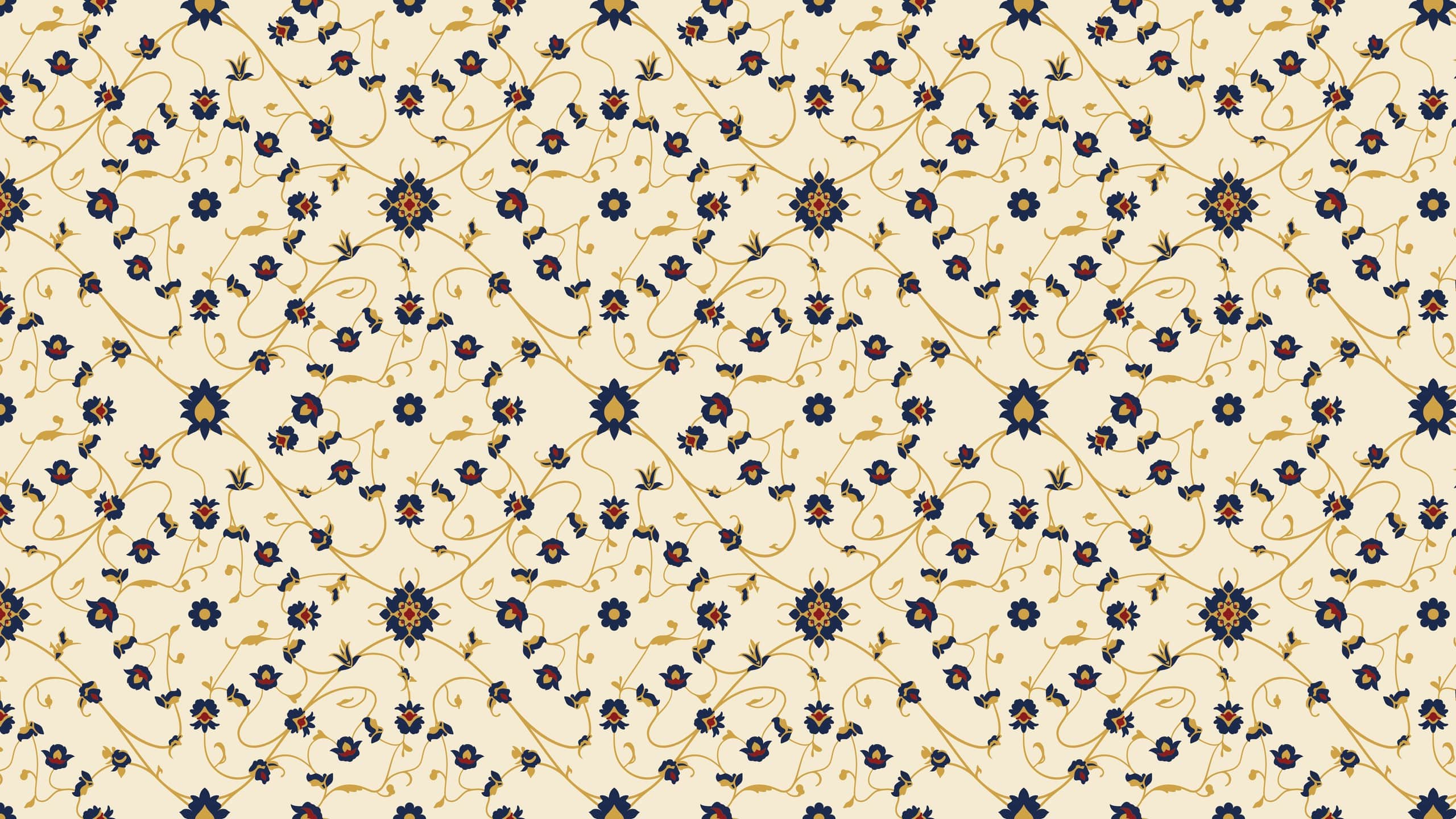
Nain
The second collection
Every collection here takes a carpet pattern and puts it on a garment.
Nain is the one where that is a return rather than a leap.
This town on the edge of the Iranian desert was known for cloth long before it was known for carpets. It wove aba — the loose outer cloak worn across the Middle East. Then that trade ended. Today Nain is a carpet name, and we are printing a Nain carpet pattern back onto cloth.
Worn closest. Seen least.
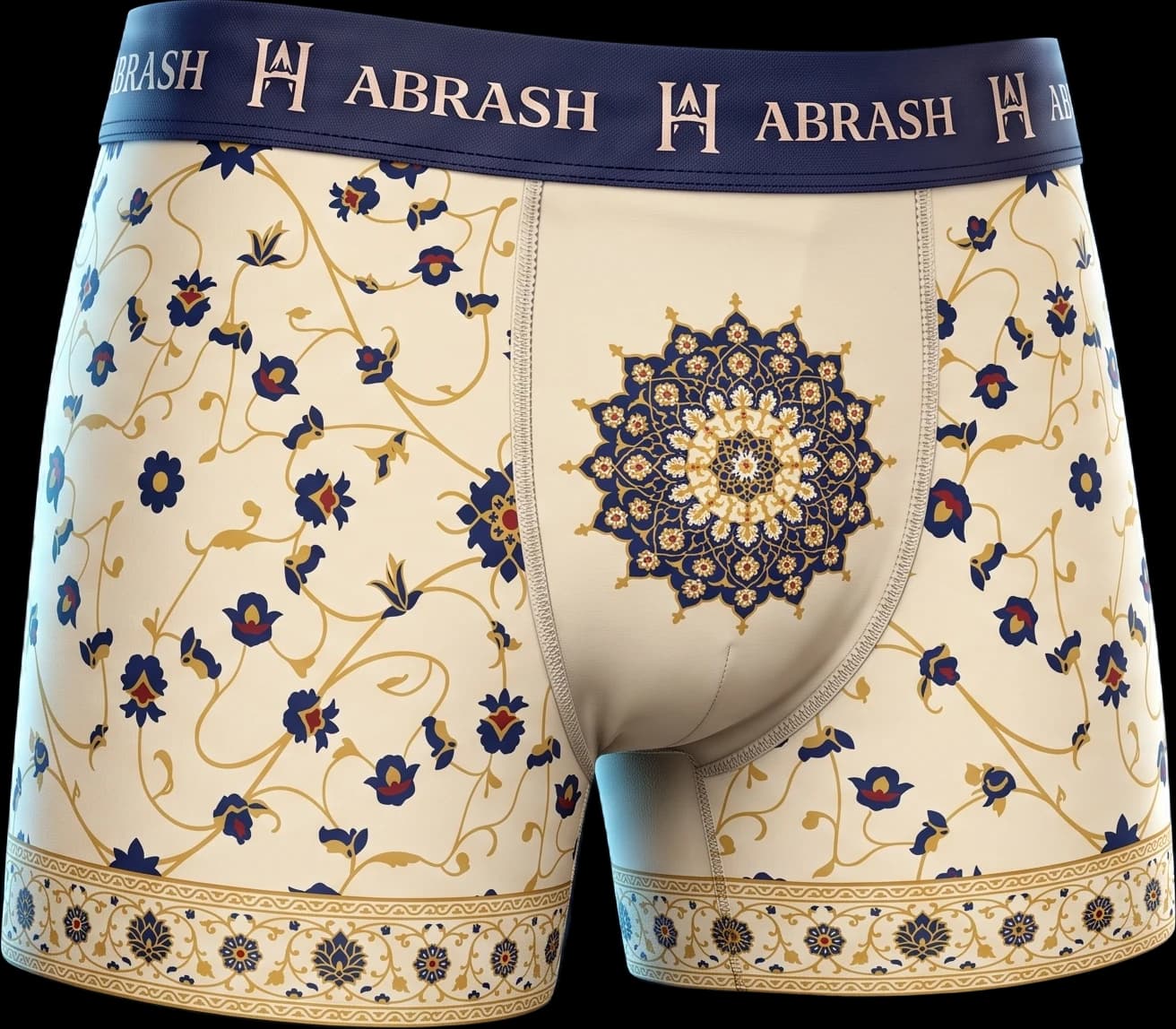
Nain is the lightest of the three. Ivory ground, cobalt drawing, gold vine — and red used so sparingly it functions as punctuation rather than colour.
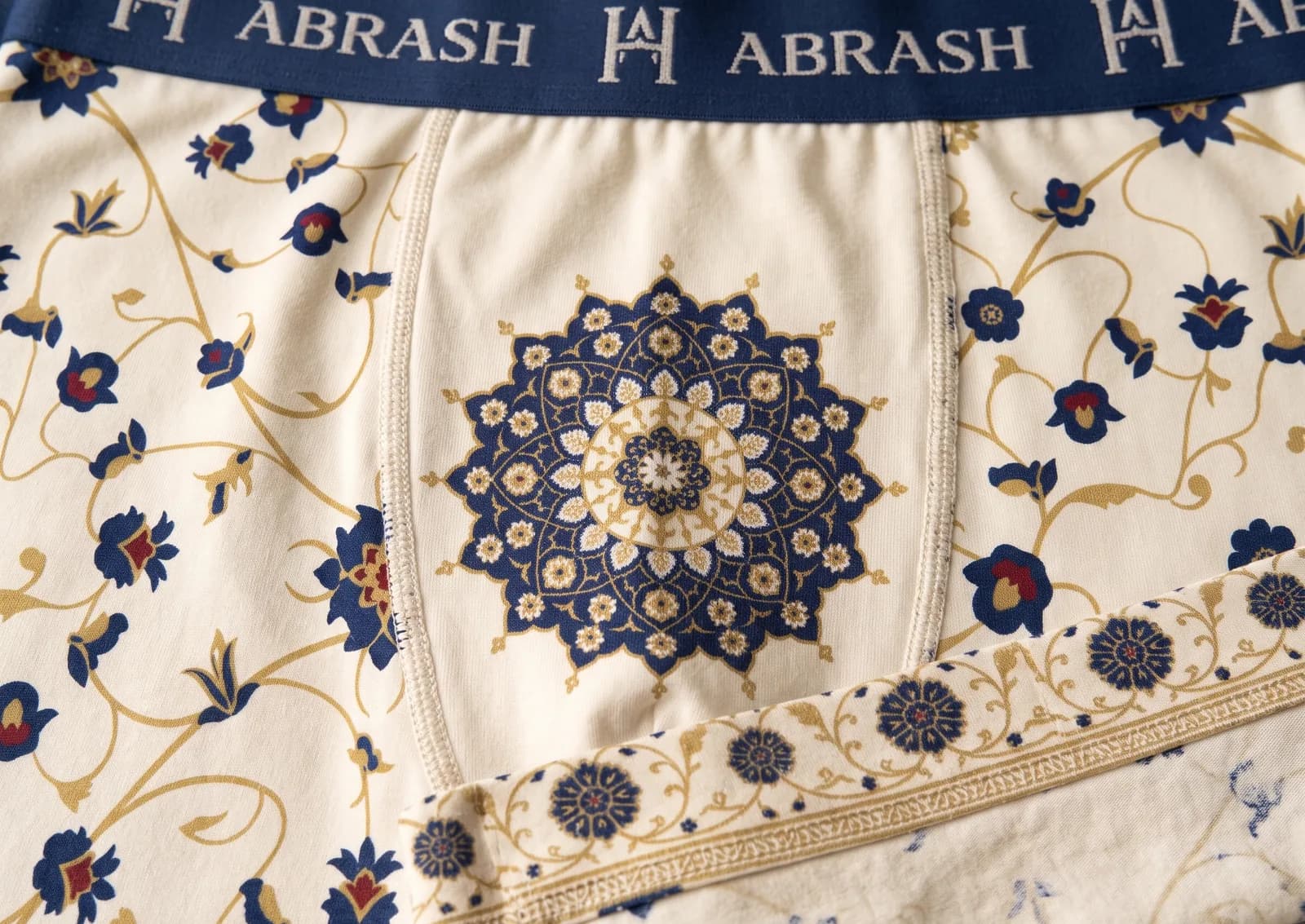
The field is a diagonal lattice rather than a centred composition. Where Tabriz builds around a medallion and holds it, Nain distributes: small flowers along a travelling vine, evenly, endlessly, drawn fine enough that the repeat is hard to find.
Set beside Tabriz it reads as the opposite temperament. Tabriz composes and closes. Nain continues.
The second half of this page is about the town, which has a stranger history than the pattern lets on.
| Fabric | 95% long-staple cotton, 5% elastane, 190 gsm |
Digital reactive, not sublimation — the colour is in the fibre, not on it | |
| Waistband | 40 mm woven jacquard, dark navy, anti-roll |
| Sizes | S – XL |
| Made in | China |
In the first run. Dye Lot 1, numbered.
Be first when Nain opens.
We are making a limited first run, and Nain is in it. Everyone on this list is offered it before anyone else, at the founders' price.
One email when it opens.
The town that wove cloaks
Nain sits in central Iran, in the arid country along the edge of the central desert, southeast of the Karkas mountains.
What it was known for was aba — the loose outer garment, worn widely across the Middle East and particularly by Arab nomads. The Encyclopaedia Iranica lists Nain first among the places well known for manufacturing aba cloth, and notes that Nain's were often made of camel's hair and intended for winter wear.
So: not floors. Clothing. And not light summer cloth either — a heavy cloak for cold weather, made from an animal built for that landscape.
Then the cloth trade ended
By the early 1920s the production of aba at Nain, described in the scholarship as "a major source of employment", had been discontinued.
The passage that records this records what it fed into. Across the Isfahan region, drought and the loss of older industries pushed towns toward carpet weaving for the European and American markets, beginning around 1921. Nain's collapsed cloak trade is named as one of those losses.
What happened next, and what we will not claim
Nain is one of the best-known carpet names in Iran. How it got there is less documented than you would expect.
The standard account is that a man named Fatollah Haghighi led the town's conversion to carpet weaving, having studied the carpets of Isfahan and Kashan and taught what he learned to Nain's weavers. That account rests on family testimony rather than archival record. We have not been able to verify it and we are not going to present it as though we had.
You will also read that Nain carpets carry among the highest knot counts in Iran. We are not going to print a number for it. The figures in circulation come mostly from sales material, and the reference works that do publish knot counts — for Ardabil, for Mashhad, for Isfahan — publish none for Nain.
That silence is consistent. The Encyclopaedia Iranica's survey of Persian carpets runs to more than a dozen articles and has no entry on Nain's. Its account of Qajar-period production names fifteen weaving centres, from Kerman and Kashan to Tabriz and Mashhad, and Nain is not one of them.
Nain is a young tradition and we would rather say so. A carpet town that appears in the record only in the twentieth century is a more interesting fact than an invented Safavid pedigree, and unlike the pedigree, it cannot be contradicted.
What we can tell you about the pattern
We can tell you what a Nain carpet looks like, because that is in front of us.
Ivory where other cities go dark. Cobalt rather than the deeper blues. A vine that travels instead of a medallion that holds. Red withheld until it means something.
What we cannot tell you, from any source we trust, is exactly how the town arrived at it. The two go together: a pattern this particular, with this little written about where it came from.
The circle
Nain's looms stopped making cloth. The town's name now belongs to carpets.
We take a Nain carpet pattern and print it on cloth.
We are not claiming to have restored anything. A hundred years and an industrial supply chain sit between those two facts, and a printed cotton garment is not an aba. But of the cities we plan to work through, this is the one where the direction of travel reverses — and it happens to be the second collection rather than something we arranged.
No object
The other collections on this site show a carpet from a museum as evidence that the pattern is older than us.
There is no Nain carpet in the Metropolitan Museum's Islamic collection, and there is not likely to be one in any comparable collection either. Those collections hold sixteenth-century court weaving. Nain enters the carpet record four hundred years later.
That absence is the most accurate thing we could show you about this collection.
About the house
House of Abrash is new. The craft is not — and in Nain's case, the craft is not as old as people assume, which is exactly why we like it.
Sources
- ʿABĀʾ — Hamid Algar, 1982
- CARPETS xii. Pahlavi Period — Willem M. Floor, 1990
- CARPETS xi. Qajar Period — Annette Ittig, 1990
- ISFAHAN i. GEOGRAPHY — Xavier De Planhol, 2006