
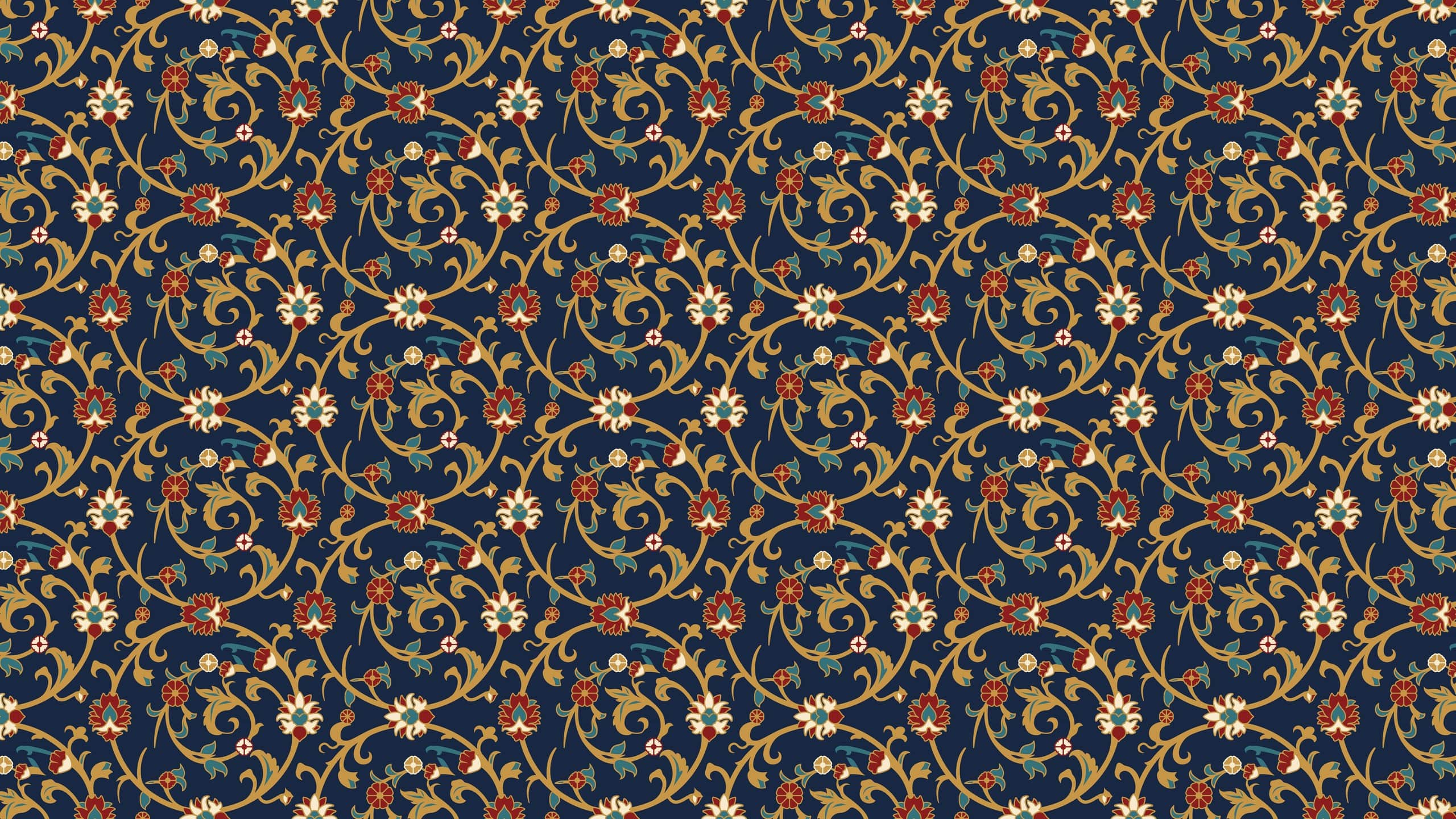
Tabriz
The first collection
A Persian carpet is the most public art there is. It is laid on a floor and walked across. It is hung on a wall to be looked at. It is made to be seen by everyone, and it has been for six hundred years.
We put it on the least public thing a person owns.
Worn closest. Seen least.
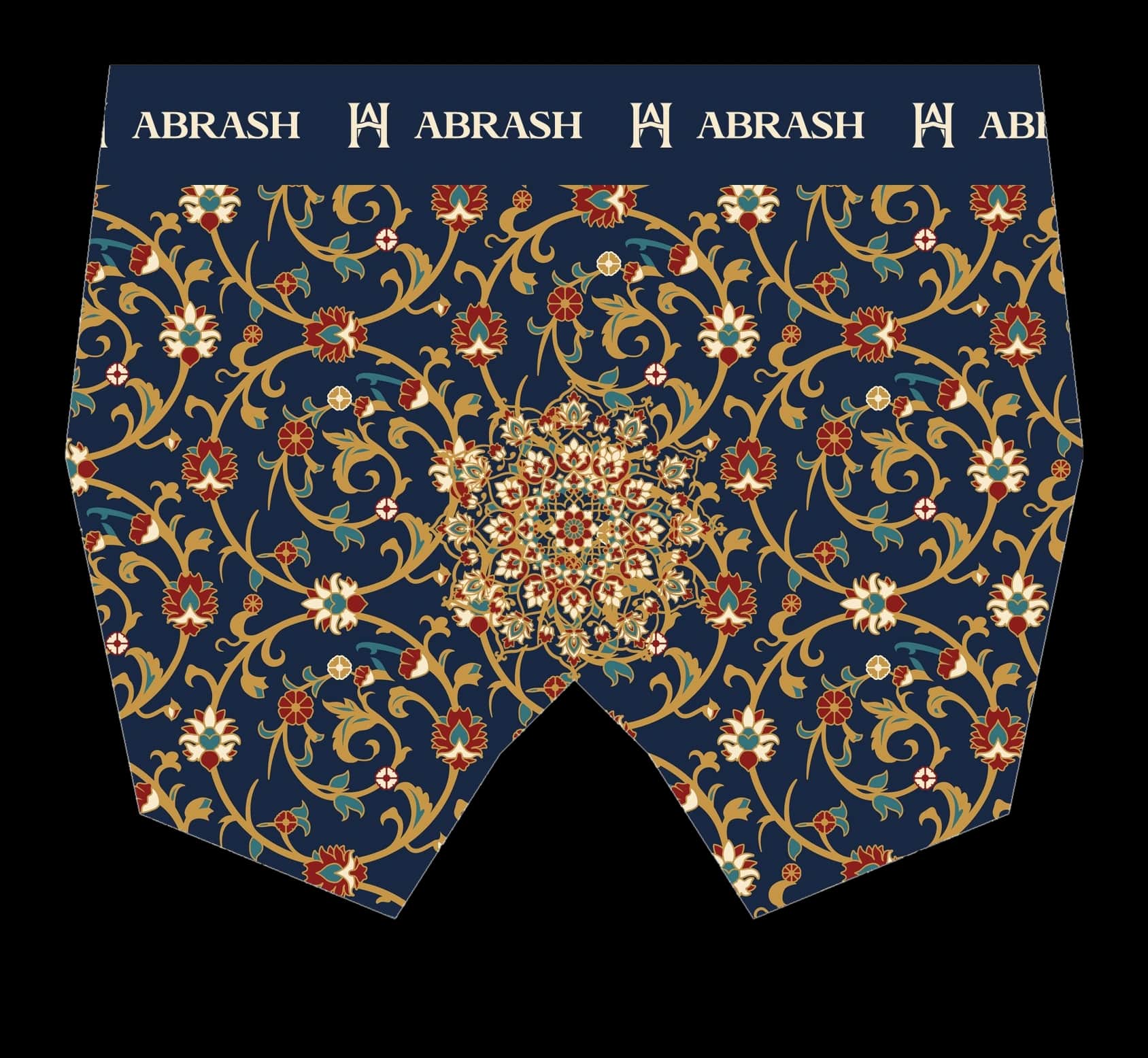
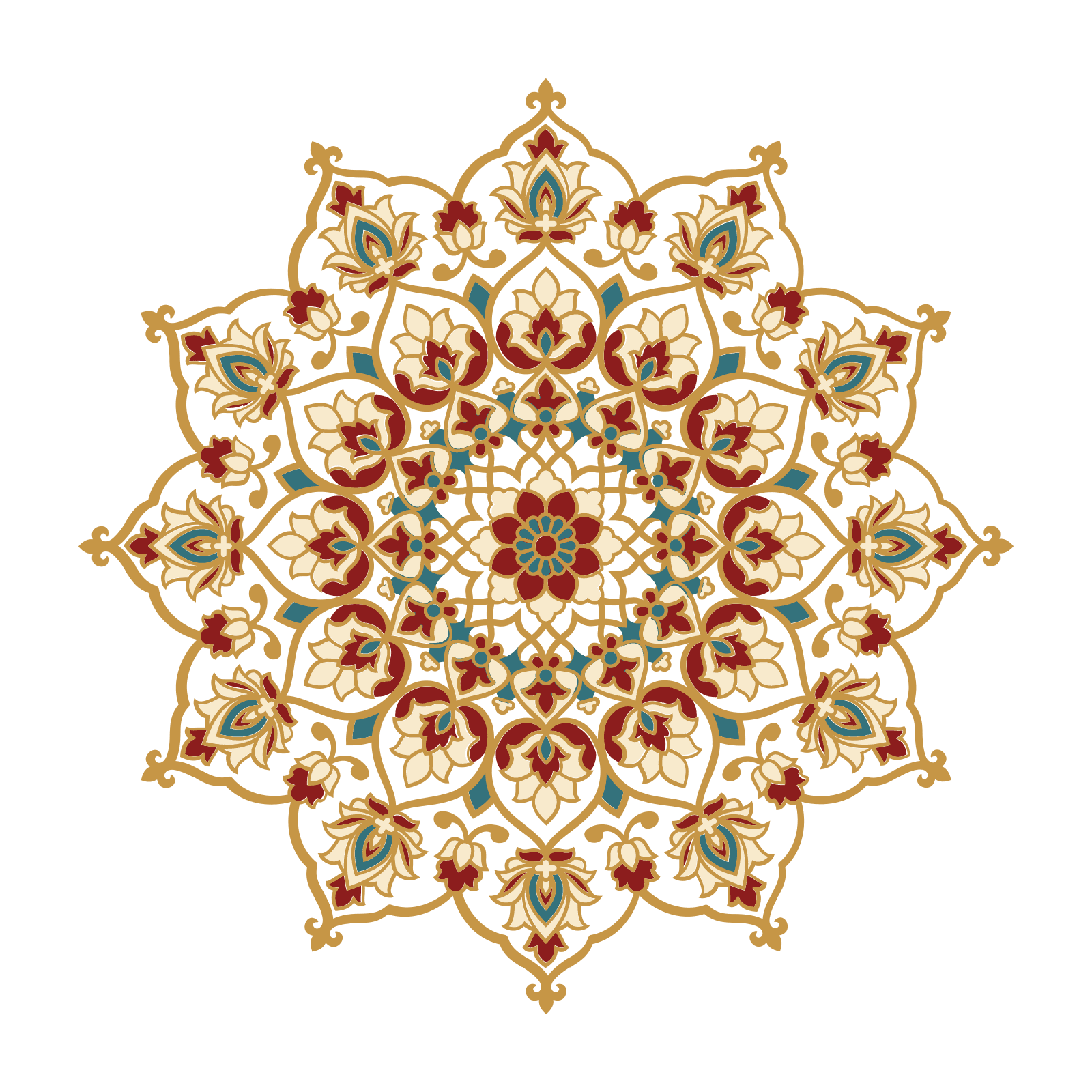
The Tabriz pattern is built the way a Tabriz carpet is built: a medallion at the centre, a field of flowering vine around it, and a border that closes the whole thing.
That is not a decorative choice. It is the architecture of a Persian book cover, and the reason for it is the subject of the second half of this page.
The medallion sits on the front. The border runs at the leg. The field carries everything between.

| Fabric | 95% long-staple cotton, 5% elastane, 190 gsm |
Digital reactive, not sublimation — the colour is in the fibre, not on it | |
| Waistband | 40 mm woven jacquard, dark navy, anti-roll |
| Sizes | S – XL |
| Made in | China |
Reactive printing costs more than the alternative and takes longer. We use it because sublimation sits on the surface of a synthetic fibre and this is cotton, and because a carpet pattern that fades in a year is a poster, not a carpet.
Shipping March 2027, for Nowruz.
Be first when Tabriz opens.
We are making a limited first run. Everyone on this list is offered it before anyone else, at the founding price.
One email when it opens. Nothing else.
The city that wove books
Tabriz was the first capital of the Safavid empire, and it kept a kitabkhaneh — a court library. That word undersells it. A kitabkhaneh was a workshop as much as a collection: calligraphers, illuminators, miniature painters and bookbinders working in the same rooms, on the same commissions, for the same patron.
Look at a Persian book cover from that period. A medallion stamped in the centre of the leather. Quarter-medallions in the corners. A border of tooled gold running around the edge, holding it together.
Now look at a Tabriz carpet. Central medallion. Corner spandrels. Framing border.
It is the same composition.
What that changed
A city carpet was drawn before it was woven. A designer — a naqsheh-kesh — worked the pattern out on squared paper, and the weaver followed the cartoon square by square. The design existed before the carpet did, on a vertical loom in a workshop, in a city with a court that paid for it.
That is why a Tabriz pattern curves. A curve has to be planned. You cannot improvise a medallion.
A nomadic carpet was made the other way round: no paper, no cartoon, the pattern held in memory and passed from mother to daughter, on a horizontal loom that was rolled up and carried at every move. The forms are angular because the knot grid is the only guide, and the grid is the grammar.
City carpets were drawn. Nomad carpets were remembered.
That single difference explains almost everything else — and it is why the weaving of the Qashqa'i of Fars, in the south, looks nothing like this.
The export century
By the nineteenth century Tabriz was Iran's foremost carpet export centre. It sat on the trade route toward the Ottoman lands and Europe, and when European demand for Persian carpets became an industry, Tabriz was where it arrived first.
The Manchester firm Ziegler & Co opened an office in Tabriz in 1867.
Twenty-one years later, the same firm bought a carpet from the shrine at Ardabil, a few days' travel to the east. It was repaired and sold on to a London dealer at 34 Wigmore Street, and the Victoria and Albert Museum was offered it.
The museum asked its Art Referee whether to buy.
The Art Referee was William Morris.
He recommended the purchase, and the Ardabil Carpet has been in London ever since — which means the central figure of the English Arts and Crafts movement is the reason one of the greatest Persian carpets sits in a European museum. Morris spent his life arguing that the machine had severed the hand from the object. He then authenticated, on behalf of the British state, a carpet that proved his case better than anything he made himself.
What we are not going to tell you
Carpet writing is full of confident claims that do not survive checking. The Encyclopaedia Iranica says so itself, and we would rather be short a good story than repeat one.
Two we have left out.
You will read that Tabriz weavers use the symmetrical "Turkish" knot, and that this explains the city's style. The knot types are real — torkibaf and farsibaf in the Persian trade's own words — but Iranica is explicit that both are used throughout the region "without respect to geopolitical boundaries or the linguistic or ethnic affiliations of the weavers." The knot does not map to the city. We have dropped the claim.
You will also read that Tabriz weavers alone use a hooked knife, and that this is why their knot counts are so high. The tool exists. The exclusivity is dealer lore, and we are not going to pass it on.
The object
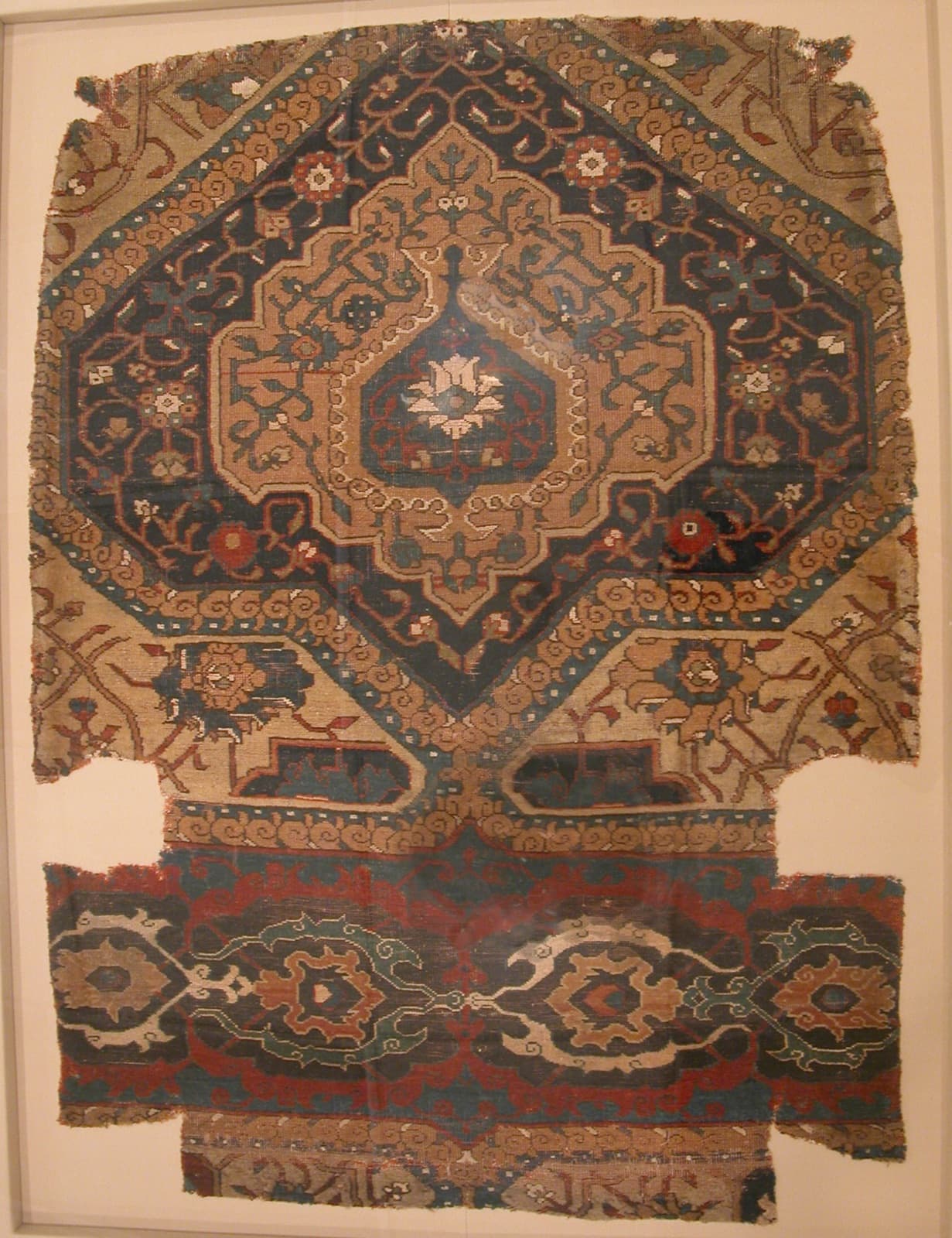
Fragment of a Northwest Persian Medallion Carpet, early 16th century. Made in northwestern Iran — the region Tabriz sits in.
It is a fragment. Ninety-eight centimetres of something that was once a floor. Most of what was woven in that century is gone, and what survives is mounted on a wall in another country.
That is worth sitting with for a moment before you scroll back up and buy underwear.
About the house
House of Abrash is new. The craft is not.
We are not going to print a founding date on anything, because ours would be 2026 and that is not the point. The patterns are six hundred years old. The house that puts them on a garment was founded in 2026, by one person, in Stockholm.
Sources
- CARPETS iii. Knotted-pile carpets: Techniques and structures — Annette Ittig, 1990
- CARPETS xi. Qajar Period — Annette Ittig, 1990
- CARPETS i. Introductory survey — Roger M. Savory, 1990
- BOYŪTĀT-E SALṬANATĪ — Birgitt Hoffmann, 1989